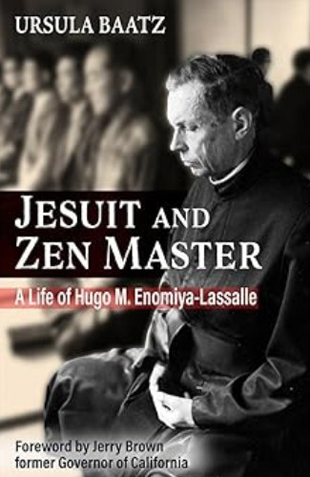
This book tells an intriguing and inspiring story of interfaith learning and interspiritual exploration — after great tragedy. Enomiya-Lassalle was a bridge-builder after the tragedies of war and collapse of civilizations. He fought in World War I and then entered the Society of Jesus (Jesuits). As a young Jesuit, he was sent to Japan as a missionary in 1929, then assigned to be mission superior of the Japanese Province six years later. In 1941, he moved to Hiroshima, establishing a novitiate there, and he was in Hiroshima on the day the United States dropped the atomic bomb on that Japanese city in August 1945.
Two years before that horrendous day, Father Hugo sat his first sesshin, the nascent beginning of his path to dual religious identity and responsibility. This book tells the story of his working for peace in Japan after the war, and then his turning more intently to Zen learning and meditation in the 1950s.
A book on Zen written by Enomiya-Lassalle in 1961 was censored by Rome. But it was also translated into six other languages, and its message spread, influencing other Christians in the West in search of how eastern religion might enliven their spiritual practice. Lassalle’s initial aim to organize groups of Zen Christian practice groups was also squashed, and he struggled with some core Christian teachings, including resurrection. As Baatz puts it: “The older he became, the less satisfied he was with the images of the old catechism.” But Lassalle did not leave the Catholic Church. In fact, in 1968 he had an audience with Pope Paul VI, who offered the Jesuit Zen master his blessing.
Lassalle learned from other East-West bridge-builders of original Christian orientation, who were his contemporaries, such as Henri Le Saux (Swami Abhishiktananda), Bede Griffiths, and Raimon Panikkar, and these relationships are discussed in the book. Father Hugo first met Thomas Merton in Bangkok on the very day that Merton died.
A glossary of terms at the back proves helpful to readers who are new to much of this material, and that will be most of us. Another added benefit is the foreword by former California governor Jerry Brown, which offers a mini-memoir of Brown’s own engagement with Zen during a six-month stay in Japan in the 1980s, inspired by Lassalle’s Jesuit understanding of zazen.