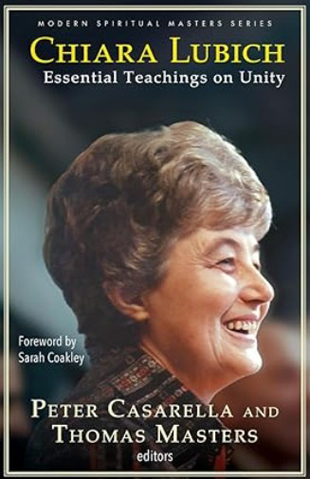
You may not be familiar with this modern spiritual master, now added to the Orbis Books series of that name. Chiara Lubich (1920–2008) was an Italian educator and Catholic activist who in December 1943 founded the Focolare Movement — a now-global organization better known in Europe than North America — promoting unity, peace, and interfaith dialogue. Founded during World War II, Lubich felt called to bring Gospel-based spiritual renewal to Europe. In the early days, the Focolare were accused of being Communist because of their experiments of living and sharing in community. Their life quickly spread to every continent, including to representatives of other major religious traditions. The Focolare are primarily Roman Catholic Christian, but there are, for example, in the United States, prominent Jewish and Muslim members as well.
Interfaith dialogue is a core value, as reflected in these writings that come from Lubich’s “movement for unity” in all walks of life, including between people of religious differences and people who differ on political issues. Lubich was widely recognized for efforts toward dialogue during her lifetime, receiving both the 1977 Templeton Prize and the 1996 UNESCO Peace Education Prize.
A foreword by Sarah Coakley, an English Anglican priest and systematic theologian at the University of Cambridge, helps to explain Lubich’s broad appeal. “[H]er writing may remind us … of striking earlier visionaries and mystical theologians,” Coakley writes, and then names among them Clare of Assisi, Julian of Norwich, Catherine of Siena, and Therese of Lisieux, referring to a theme at work that is either “feminine spirituality,” or better, “reoriented humanity.”
An introduction by the editors sets the stage as well, with a timeline of events and brief introductions to each section of writings.
The first part of Lubich’s writings is designed to explain the origins of her awakening and the start of her movement. Then come the core of the work: writings gathered around the topics of “Going to God Together,” “Living Jesus Within,” and “Living Jesus Within Relationships.”
The first selection from “Going to God Together” leads with what is the primary theme of Focolare spirituality, referred to as “Jesus Forsaken,” a poignant and telling image of Christ on the cross. Lubich explains:
“I do not remember the way things happened exactly, but deep within me the conviction was taking root, with the practice that went with it, that ‘Jesus Forsaken’ effectively summed up the whole of the Gospel. And that, in loving Him, all the virtues would blossom. In Jesus Forsaken there were all sufferings, all loves, all virtues, all sins (since He had made Himself ‘sin’) and in Him we all found ourselves in every instant of our lives.”
The same theme (among dozens of others) appears again many times in these writings, for instance, in part four, “Living Jesus Within Relationships,” when Lubich teaches:
“Jesus Forsaken — who went beyond his own infinite suffering and prayed: ‘Father, into your hand I commend my spirit’ (Lk. 23:46) — also teaches us to see difficulties, obstacles, trials, hard work, error, failure, and suffering as something that much be faced, loved, and overcome. Generally we humans, whatever our field of endeavor, seek to avoid such experiences in every way possible…. For us, instead, precisely because of our choice of Jesus Forsaken, every difficulty is to be faced and loved.”