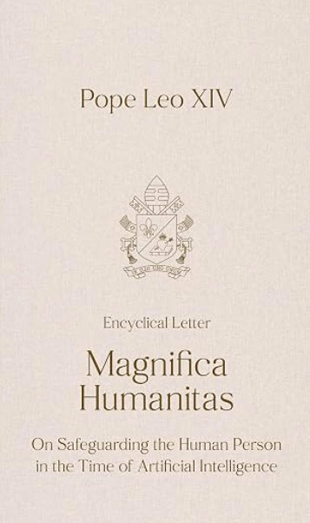
A pope doesn’t need our help to promote his work, but we couldn’t not review this one. It is too important. This is not a Catholic book per se; it is for people of all backgrounds concerned that Artificial Intelligence might be used to diminish humanity.
Leo made sure that it published on the very day 135 years after his predecessor Pope Leo XIII’s landmark encyclical, Rerum Novarum, was published to address what were then the dangers to humanity of the Industrial Revolution. Leo intends Magnifica Humanitas to serve as a framework of caution around today’s digital revolution — not just for the people of his church, but as a contribution to a conversation going on in every part of the world.
“Encyclical” is the term for a major document written by a pope, equivalent to a religious book. Many readers will remember the immediate predecessor of Leo, Pope Francis, for his most important encyclical called Laudato Si, about the climate crisis and care for our common home.
Like most papal encyclicals, this one is organized with chapters (five, plus an Introduction and Conclusion) as well as the sequential numbering of paragraphs (in this case, #1 through #245). When quoting an encyclical, one usually refers to the paragraph number.
Leo’s message is not proscriptive, but cautionary. Starting at #7, he uses a story from the Bible — the Tower of Babel — to frame what is happening with AI in the enthusiasm with which it has been greeted by the capitalist structures of governments and global business. In that story, which is meant to be a metaphor, human beings attempt to build a city so tall and grand that it replaces the need for God on earth. “It was an impressive feat,” Leo writes, “a single language, a single technology, a single direction.” But it failed, Leo says, due to the arrogance of its creators.
You may be surprised at how much you agree with this author, who writes without reference to old doctrinal saws that are more likely to separate Catholics from other people of faith or good will. For example, when Leo writes about the tendencies of our modern world, in #118, I imagine most readers nodding approval: “Everything that appears as a ‘limit’ — incapacity, illness, old age, suffering, vulnerability — tends to be seen primarily as a defect to be corrected, rather than as a reality through which our humanity matures and opens itself to relationship.” Instead, he says, “we must remember that humanity flourishes not despite limitations, but often through them.” He says all of this in the context of praising what he calls “the heart and the grandeur of the human person” and how that ought to be respected in and through the development of any new technologies.
He also praises what he calls “the civilization of love” and argues that we should support and foster every aspect of how to build such a civilization. Where and when AI does not seem to support it, Leo says it is to be curtailed. By the end of the book, he also turns to reflection on Jesus Christ the Son of God, as every pope is sure to do, and says that the Son of God “entering into our human condition” is the source of humanity’s grandeur.
See the excerpt accompanying this review for a sampling of how Leo points to Christ in saying that AI can never love or have a conscience.
This is a book of Christian humanism on one of the most important topics today, that hopes to be read by every thoughtful person.