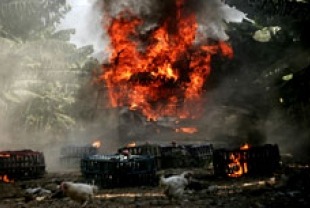
The warrior mentality is promoted all around us. It presents a romantic vision of what fighting, battle, and winning are all about. The seeds of war are planted when we begin to see the other as the enemy, when we justify our own violence as a necessary antidote to a dehumanized other. Twenty-five years after his participation in the Israeli war against Lebanon in June of 1982, Samuel Maoz wrote the script for this gripping and powerful antiwar film. In an interview he has stated:
"I wrote Lebanon straight from my gut. My memory of events themselves had become dim and blurred. . . . What remained fresh and bleeding was the emotional memory. I wrote what I felt. I wanted to talk about emotional wounds, to tell the story of a slaughtered soul, a story that was not found in the body of the plot but derived from deep within it."
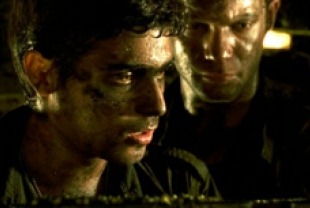
Four Israeli soldiers are in a tank on the morning of June 6, 1982: commander Assi (Itay Tiran), loader Hertzel (Oshri Cohen), driver Yigal (Michael Moshonov) and gunner Shmulik (Yoav Donat). These young men in their 20s are not gung-ho warriors. In this dark and dank machine, they go into combat. Assi is the quiet leader who seems unequal to the task whereas Hertzel is a cocky fellow who has learned to assert his will in order to get what he wants. Yigal has only one thing on his mind: getting home safely and letting his mother know that he is okay.
The domineering commander in the field is Jamil (Zohar Strauss) who is angered when Shmulik's hesitancy to blow a car away with a terrorist in it causes one of his men to be mortally wounded. Jamil soon is barking orders to these inexperienced young men; he wants them to kill anything that moves as they enter the already bombed city. Shmulik's mettle is tested when they come upon some civilians captured by the heavily armed enemy. The men in the tank are joined by a Syrian hostage (Dudu Tassa) and don't know whether to trust a raging Phalangist (Ashraf Barhom), who is supposed to lead them out of the city. Amidst all the destruction and the violence, there is one act of human kindness which involves one of the Israeli soldiers and the Syrian prisoner.
Lebanon vividly conveys the ways in which war can scar the soul and the mind. It is easy to see how one soldier loses it and why the others will replay some of the most terrifying moments in the tank again and again in their heads after they return home. The war is never over for many of those who fight and experience fear in the deepest level of their being. The war is never over no matter what the withdrawal date. As Lebanon reveals: war is a hell of a survivor.
Special features on the DVD include "Notes on a War Film."