
One of the skills we most need as we bring the best of ourselves to the practice of democracy is patience. And that will never be more true than in the days (and weeks) after the United States’ Election Day on November 5.
What does it take to be patient when it feels like everything is on the line, and nothing can be done until we know, and we don’t know when we will know?
In the Alphabet of Spiritual Literacy, there is no P for patience. There is B for being present. Patience is practicing presence. When we are present, we turn our whole attention to the current moment, not to the past or the future.
Being present calls my attention to my body, which always exists in the present moment.
Every moment holds more meaning than we can possibly know. When we pay attention to the present, we experience existence as deep and layered; there is never enough time to interpret what our senses receive in the present, much less enough time to worry about the past or future.
We are part of a very big story.
We are part of a very big story. And it unfolds in every moment.
The practice of presence reminds me of that. When I worry about what is coming next, I waste time, mind space, energy, and my precious emotional capacity on the illusion of control — and neglect whatever needs my attention in the present.
In the book of Matthew, Jesus is supposed to have said, “Give your entire attention to what God is doing right now, and don’t get worked up about what may or may not happen tomorrow. God will help you deal with whatever hard things come up when the time comes.”
In less free translations, Jesus’s last sentence is more succinct: “Today’s trouble is enough for today.”
On November 5 or 6 or 7 or . . . as we wait, we might translate this aphorism through our own experience, and simply say, “Today really sucks.”
We will not know who the next president is on Election Day. And we will not know when we will know.
What will we do between voting and knowing? How will we spend our time between voting and knowing in a way that does not waste our precious energy, feelings, intellect, and time?
We can plug into a bigger story. A story that is always unfolding and making the present quite enough.
I met recently with the members of the Interfaith Reading Group. We meet every month on the third Thursday.
This month, one member talked about her discomfort walking into a temple and seeing all the statues of the Buddha. She was drawn to Buddhism but grew up Jewish and felt uncomfortable with the statues. She traced this tension back to the Second Commandment, a Jewish law against making “graven images,” physical representations, of God.
Another member, a lay leader at her Conservative temple, was delighted to share a reframing from Rabbi Yael Levy, who refers to the Commandments as Utterances. Here is the Second Utterance: “You cannot arrest me in motion. You cannot grasp or hold onto time. Do not strive for certainty. Do not seek permanence.”
Instead of a prohibition against “graven images,” the utterance is a warning not to make God small, certain, or static.
I can still feel the wave of gratitude that washed over me when she said that. I needed the reminder that God is huge. God fills every moment with a becoming we cannot fully comprehend.
Our story, God’s story, the spirit’s story, the universe’s story — however you language it, it offers us a way out of smallness, a story grander than one election and its results. It lures us away from the comfort of certainty and invites us into the comfort of mystery: the comfort of knowing there is a larger story unfolding that we do not know the end of.
Here are some ways to weather the waiting and find transcendence in the present moment.
 This quote from Catholic mystic Henri Nouwen reminds us that in the present we can see the first rays of God's glorious coming.
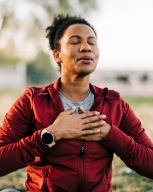 Our breathing can help us live in the moment, and “The Physiological Sigh” is a special kind of breath that can release anxiety. I suggest making the exhale noisy!
 I love the whimsy of this practice by Bradford Keeney, who suggests making a piggy bank for your worries. There are many ways to adapt this practice to make waiting a fun thing for your family, housemates, co-workers, classmates, friends, etc. You might up the ante from a quarter to a dollar. You could make the “pig” any shape you want and even construct it yourself out of now obsolete election materials: sample ballots, mailers, “I voted” stickers. Finally, you could plan to do something with the money that celebrates togetherness, so that waiting on the unknown becomes waiting for a fun gathering funded by the worrying money.
- See more Spiritual Resources for the U.S. Election Year.
- To receive these weekly features in your inbox on Mondays, subscribe to the Practicing Democracy Project email list here.