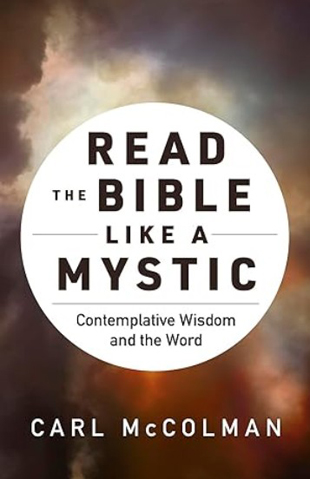
Author Carl McColman is part of our Living Spiritual Teachers Project. We’ve long turned to Carl as a writer and speaker about contemplative living, author of many helpful books, and a retreat leader and spiritual director with a perspective that begins in Christianity but generously integrates other traditions as well.
McColman is clearly reaching out to Christians who approach faith as a matter primarily of belief, wanting to show them why and how “Bible” and “mystic” belong together. But perhaps more importantly, his new book seems to be ideal for Millennial and Generation Z readers, not raised in churches as their parents and grandparents probably were, who come to spiritual practice with assumptions about what the Bible is and isn’t. In other words, this book speaks to the spiritual but not religious (SBNR), asking them to consider the Bible with fresh eyes. McColman wants you to look again, or for the first time, at what the Bible says when it’s read with a mystical heart.
In a chapter called “Can the Bible Be Saved?” McColman mentions the many good reasons why smart people avoid the Bible today, admitting clearly that certain “passages truly are appalling,” but then also writes: “The Bible contains some of the greatest spiritual writings of all time,” and goes on to name “the Beatitudes, where Jesus offers a beautiful vision of ethics based not on power but on humility and peacemaking”; “psalms, ancient Hebrew poems and hymns that describe a God of great compassion and deep beauty”; and “many luminous and love-infused passages.”
Most of all, McColman wants people to realize that the Bible is about, more than anything, love. In a late chapter, “Seven Keys to Unlock the Bible,” he offers these as ways that we, as readers, should approach these texts that are still sacred: with humility, with love, in conversation, for seeking wisdom, for justice, in prayer, and in mystery.