Last month, I started a gathering called The Table in my neighborhood. We meet at a brewery down the street. The Table is a space for people who don’t want “church” but do want spiritual fellowship; we share stories, process life, and connect to the Beyond, however we each define it.
Last Wednesday, as we were talking about what makes a place sacred, I was distracted by groups of people who had settled at the tables around us. I could tell that they, too, were involved in something intentional.
They seemed to be writing as they were chatting. I leaned over and asked what they were doing. They were writing postcards in support of a woman running for City Council. They were excited to tell me about her, how she grew up in the neighborhood, got her law degree as a single mom, and defends tenants in this rapidly gentrifying neighborhood.
I then told them why we were there, and they wanted to know more about the community we were building. They started skeptically with, “What kind of spirituality…?” and after I explained, one woman said, “I’ve been looking for something like this,” and asked for my email.
This connection buoyed me. There we were at The Table, thinking about how places become sacred and what role human creation plays in that. We reflected that some places inspire reverence because we sense the overwhelming and direct presence of the divine. These are often ancient or natural phenomena and are known as “thin” places, places where the divine realm breaks into the human realm.
But we also shared about places that were made sacred because of human interaction, because the spirit drew strangers and friends together in community, breaking down the barriers between self and other in the human world.
When I interrupted the postcarders, I broke one of those barriers. We had gathered for different reasons: the Tablers for spirituality, the postcarders for politics. We were also strangers to one another.
But I leaned over, and they leaned in. And in some small way, our interaction wore down the unnecessary barriers between the political and the spiritual and between stranger and friend.
I think that, when we transcend these barriers, we start wearing away another kind of “thin” place, a place where the spiritual is the political, where the self is the other. A place where we see one another as whole beings, not as this or that. A place where we stop respecting the unnecessary and imaginary barriers that keep us apart (and also keep solidarity and progress in check).
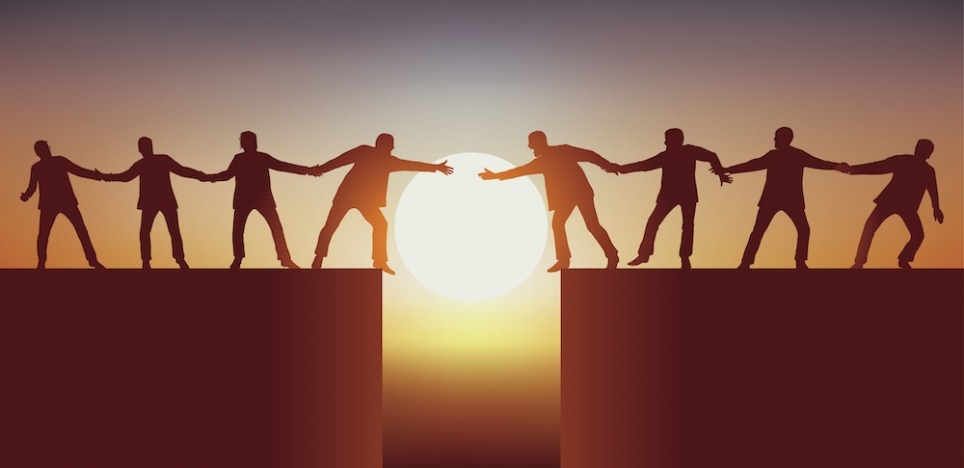
To create these thin places in our communities, the challenge for all of us is to stand perpetually at our edges, reaching across the separations. The challenge for all of us is to forgo the boxes we sometimes nestle in so that we are ready, when opportunity arises, to set aside convention and lean over to another table.
“The readiness is all,” and these resources can help equip us to create thin places in our communities.
These two poems can be used as prayers or grounding practices each time you leave your home: "Knowing How Our Lives Intertwine” and “All Things”
In this practice from Urban Mindfulness, Jonathan S. Kaplan offers some practical, easy ways to connect with those around us.
In this short reflection, Barbara Ann Kipfer contrasts the stress of separateness to the relief of interconnectedness.
- See more Spiritual Resources for the U.S. Election Year.
- To receive these weekly features in your inbox on Mondays, subscribe to the Practicing Democracy Project email list here.