Belong to the World Bring Your Tribe
Spiritual Quotation
This book comes with a recommendation on the cover from one of our favorite Living Spiritual Teachers, Rami Shapiro, describing it as a “vision of a Jewish future that is nondual, universal, integral, inclusive, detached from political Zionism, aligned with liberal democracy, and open to learning alongside and from other religions.” That says it very well.
Lauren Zinn has been a Jewish leader and trained interspiritual minister in Ann Arbor, Michigan for decades. “Belong to the World” and “Bring Your Tribe” are parts one and two of her book, which detail the vision Rami describes. Part three, “Become Interspiritually Jewish,” is where Zinn brings it together. There are chapters about making observances of Hanukkah, Purim, Passover, Yom Kippur, and Shabbat into interspiritual occasions. Zinn wants to see Jewish communities commit to building relationships and friendships by sharing in each other’s religious lives.
There’s another important chapter on how Jewish practice can be consciously “Ramadan Adjacent”; it is full of ideas on ways to do this starting with “Pick a day to fast with Muslims,” and continuing to include ways Jews can learn from Muslims how to break a fast most inclusively: “I learned about Ramadan and its various practices across different Muslim cultures. The image that stands out is of communities laying blankets on sidewalks covered with dish after dish of food for the sundown meal — for all to come and eat, especially those who are hungry and needy. Ramadan cultivates compassion. It made me want to see and experience this compassion in Judaism and to appreciate it when I saw it, for example, at the Passover Seder. This experience of interdependence, of leaning about our own and others’ holidays through each other, is a feature of the Interspiritual Age.” Always, Zinn is aiming to inspire based on her own experiences in the field.
This book is self-published, but it is readily available from major booksellers.
Building an interspiritual Jewish practice.
Lovingkindness for All Children
Spiritual Quotation
O Compassionate One, help us to have the same love and concern for all children - especially the poor and the homeless - as we have for our own children and grandchildren.
Worldwide Ranking: Rank of the United States, out of 29 developed countries, in overall child well-being: 26 (United Nations Children's Fund, 2013)
May all children be free of suffering. May all children be well. May all children live with ease, assured of the necessities of life. May all children know peace and joy.
O Compassionate One, help us to have the same love and concern for all children - especially the poor and the homeless - as we have for our own children and grandchildren.
Worldwide Ranking: Rank of the United States, out of 29 developed countries, in overall child well-being: 26 (United Nations Children's Fund, 2013)
May all children be free of suffering. May all children be well. May all children live with ease, assured of the necessities of life. May all children know peace and joy.
Thich Nhat Hanh, Joyfully Together
Spiritual Quotation
The Seven Practices to Remove Disputes and Conflicts
1. All parties should be present in a meeting to share their suffering.
2. All parties should remember and recount the details of the conflict.
3. It should be determined that neither party is mentally ill.
4. The parties should confess their own unskillfulness.
5. A committee is assembled to investigate the nature of the conflict.
6. A majority vote is used to resolve the conflict.
Respected senior members of the community are invited to declare a general amnesty.
Seven Practices to Remove Disputes and Conflicts
Mary Margaret Funk, Islam Is
Spiritual Quotation
The revelation in the Qur'an is that in this world the rich must give to the poor to guarantee a place in heaven with the angels and Allah. In practice, therefore, almsgiving is an insurance policy to be entitled to heaven. The gathering of alms also exemplifies to Muslims that they are an umma, a community.
Such generosity is based on two teachings. First, as we have seen, all goods are gifts of God and God has told us to share them. Secondly, these gifts are blessings and rewards from God and will be taken away if not used rightly. For Muslims, giving to the poor is not optional; it is the duty of bowing with one's goods. There are no exceptions — all are expected to give annually. In practice, this means that a Muslim who makes $40,000 gives about $1,000 off the net income.
Giving to the poor is not a matter of mercy or charity on the devotee's behalf. It is a matter of justice.
For the Muslim, God does not plan for his creatures to be poor. A Muslim feels blessed for being alive and understands that he is created by God and so surrenders his life to God. As part of his surrender, islam, the Muslim provides for the poor and thus receives God's mercy and goodness through economic prosperity.
The Muslim provides for the poor and thus receives God's mercy
David Spangler, Everyday Miracles
Spiritual Quotation
Service can be housing the homeless, but it can also be creating a loving and nurturing atmosphere in your own home for those who share it with you or who enter into it. It can mean creating an empowering and creative environment where you work. Service can also mean acts of meditation and silence that help to heal the noise of confusion, fear, hatred, and pain that swirl through our collective psychic environment.
Acts of meditation and silence that help to heal the noise of confusion
Being Black
Spiritual Quotation
"Express your creativity regardless of whether or not you feel you are an 'artist.' Get paints and a brush and make art.
"Nourish and protect your body. Choose healthful foods that have been grown and produced in the best way possible.
"Stimulate your mind. Find new music that moves you.
"Pay attention to yourself. Go away for a weekend alone, or spend a day in silence.
"Revel in the magical quality of moving water. Walk on a beach or a pier or along a riverbank.
"Wake your body up, exercise your lungs. Lift light weights, run, jog, walk, or play any sport that requires you to get a little out of breath.
"Lighten your burden. Seek and ask for help when you need it or just talk out your problems with a friend, family member, or therapist.
"Share yourself. Make time for uninterrupted interactions with your family and loved ones. Spend time with them both in groups and one-on-one.
"Be at ease. Take ten very deep breaths, holding each for a few seconds before exhaling and relax in the arms of your lover.
"Foster intimacy. Sit face-to-face with a person you care about for at least five minutes. Without speaking, simply look into each other's eyes, trace every line of their face. Let self-consciousness melt away.
"Honor what you love. Create an appreciation altar and adorn it with pictures of people you love, mementos and trinkets from your life, flowers, art, and objects you think are beautiful.
"Make every space sacred and worthy of attention. Make your bed every morning and clean off your desk every evening. Pay attention to the details of your life and respect order as a powerful tool.
"Use rituals to intensify your connections. Light candles and incense for no special reason. Reflect on where you are going and how you are feeling.
"Invoke the power of sound and rhythm. Repeat special sayings, poems, or sounds that feel good to you. Let these be your mantras or personal energizers.
"Build support for your spiritual practice. Find a spiritual partner, teacher, or guide whom you can talk with freely about your practice and vision of life.
"Be consistent and holistic. Make a conscious effort to practice good for each aspect of your being. Practice good for your mental, physical, emotional, psychic, and spiritual being every day you are on this earth."
Ways to explore yourself and find the things that nourish you.
At Middleton
Spiritual Quotation
George (Andy Garcia), a heart surgeon, has arrived at Middleton, a college with a picturesque campus, with his son Conrad (Spencer Lofranco) who is not interested in attending this school. He resents being forced to take a look at the place when he could be elsewhere. Even worse, George makes him wear a tie.
As a laid back and clever student begins leading the tour for prospective students, another parent, Edith (Vera Farmiga), embarrasses her daughter Audrey (Taissa Farmiga) with some awkward and pressing questions about crime on campus. George, who is a straight arrow kind of guy, is turned on by several verbal sparing sessions with this idiosyncratic woman who convinces him to leave the tour and strike out with her on their own.
They borrow some bikes and explore around, then climb to the top of a bell tower where Edith convinces George not to give in to his fear of heights. Later, we discover these two both have unfulfilling marriages when they are cajoled by a drama teacher to improvise a scene as an unhappy couple.
The saving grace of this romantic comedy is the spunky screenplay by director Adam Rodgers and Glenn German. These two middle-agers are still learning how to let go of their children and move on in their own adventures. Meanwhile, their children are sorting out their options. Audrey pursues her dream of studying with a linguistic professor (Tom Skerritt) she adores and Conrad connects with a radio deejay (Peter Riegert) who convinces the boy that he has the right stuff to learn the ropes of this business.
Andy Garcia proves once again that he has a penchant for comedy as he revealed in City Island. Vera Farmiga's Edith comes across as an abrasive middle-aged woman but when she flirts and flashes her deep blue eyes at George, he is putty in her hands. Her real-life sister Taissa impresses with her feisty depiction of Audrey who swings easily between one volatile mood to another — just like her mother.
A delightful romantic comedy about two middle-agers learning the hard lessons of letting go.
Welcome to the Ritual Space
Spiritual Quotation
Ritual. When you read or hear that word, what does it conjure up for you? For me the word recalls Sundays in the Catholic church of my adolescence with candles and incense and Latin. But not just the rituals of that formal setting. I also think of all the informal rituals I've been performing all my life: dancing alone in my room as a teenager as a literal escape from bullying, the morning practices of my adult years (journaling, prayer beads, yoga), my sometimes over-the-top holiday decorating, the little daily rituals I share with my cats.
Rituals are everywhere. They are most often associated with religions as every tradition and path has oodles of them. Congregational worship services are punctuated by well-defined rituals. So are the customs and traditions of indigenous peoples: ceremonial dressing, dancing around a fire, smoking a peace pipe. Broaden your perspective a bit, and you'll see that other areas of community life are filled with ritual activities: the opening coin toss of a sporting event, the ringing of the opening and closing bell at the Stock Exchange. In our homes, we may have morning rituals around getting up and bedtime stories for children.
Ritual. When you read or hear that word, what does it conjure up for you? For me the word recalls Sundays in the Catholic church of my adolescence with candles and incense and Latin. But not just the rituals of that formal setting. I also think of all the informal rituals I've been performing all my life: dancing alone in my room as a teenager as a literal escape from bullying, the morning practices of my adult years (journaling, prayer beads, yoga), my sometimes over-the-top holiday decorating, the little daily rituals I share with my cats.
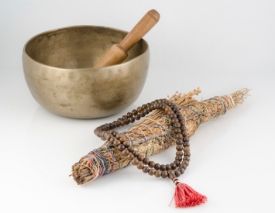
Rituals are everywhere. They are most often associated with religions as every tradition and path has oodles of them. Congregational worship services are punctuated by well-defined rituals. So are the customs and traditions of indigenous peoples: ceremonial dressing, dancing around a fire, smoking a peace pipe. Broaden your perspective a bit, and you'll see that other areas of community life are filled with ritual activities: the opening coin toss of a sporting event, the ringing of the opening and closing bell at the Stock Exchange. In our homes, we may have morning rituals around getting up and bedtime stories for children.
Anniversary of Seeds of Peace UNESCO prize
Spiritual Quotation
November 17 marks the anniversary of the UNESCO Peace Prize award to Seeds of Peace, a charitable organization founded in 1993 to encourage friendship among youth whose ethnic or national groups are in conflict. Seeds of Peace affirms that while governments negotiate treaties, “peace is made by people."
Participants in Seeds of Peace summer camps learn conflict-resolution skills and discard entrenched beliefs that members of a particular group are to be considered enemies. Living and working together as friends, they build mutual respect and understanding.
At the presentation of the UNESCO Peace Prize to Seeds of Peace on November 17, 2000, then Secretary-General Kofi Annan offered these words of praise: "There can be no more important initiative than bringing together young people who have seen the ravages of war to learn the art of peace. Seeds of Peace is certainly an example of the world the United Nations is actively working for."
Visit the Seeds of Peace website.
Quotes
Teenagers engaging with peers from "the other side" at Seeds of Peace development programs gain vital perspectives to bring home with them. Here is a sample:
"After the last war in Gaza, children stopped asking each other questions and, instead, started hitting each other. I fear that the children are losing their ethics and turning to a violent side, so I want to help them grow the goodness they have inside. I want them to learn about the concepts of human values like freedom, respect, and accepting the other — to have dreams and build their futures."
— Lubna, Palestinian Delegation, 1994 and Seeds of Peace Fellow, 2015
"My hope is that meeting the 'other side' will affect their lives as much as it has affected mine. I feel very privileged to have had Seeds of Peace open my eyes at a young age, and I cannot think of a worthier goal than educating other young people in the same values of dialogue, openness, and collaborative work towards peace."
— Hamutal, Israeli Delegation, 2005
"I founded Aamney Samney ('Face to Face') which connects Indian and Pakistani students by finding common ground to resolve the conflicts between them. We use social media to host a virtual program of dialogue and sharing, though which stereotypes are challenged and friendships are built."
— Jehan, Indian Delegation, 2008
"It is only through the forging of strong relationships and a genuine interest and appreciation for the stories of others that we can hope to bring peace to the world."
— Joseph, American Delegation, 2004
Spiritual Practices
To celebrate this day, create two columns on paper or on your favorite electronic platform. In one, jot images and ideas related to any conflicts in values you felt towards others in your youth. In the other, record the ideals you held as a young person: any ways in which you wanted to change the world.
When you're done, look back on these conflicts and ideals. How have each of them shaped your life? Do they remind you of anything to brighten the world that you've left undone and would still like to pursue? Find a specific way you can start today.
Celebrating a group that encourages friendships among youth as they learn the art of peacemaking.
All That We Share
Spiritual Quotation
All the world's religions and wisdom traditions hallow the process of human caring and sharing as an expression of community. In these desperate times when there are so many homeless, so many who are unemployed, so many who are anxious about their financial future; it is evident that our market-driven society is failing millions of people. The signs indicate that things are not going to get much better, except, perhaps, for the rich.
It's time we moved from a "Me" to a "We" society. Jay Walljasper's new book, which is subtitled "Field Guide to the Commons," calls for just such a paradigm shift from competition to collaboration. In the process, he and the other writers in the paperback offer solutions to some of the most worrisome social, economic, and political problems of our times.
Jay Walljasper is the author of The Great Neighborhood Book and editor of On the Commons.org, a movement strategy center connecting organizations and communities with new ideas and tools. Walljasper defines the commons as:
"A wealth of valuable assets that belong to everyone. These range from clean air to wildlife preserves; from the judicial system to the Internet. Some are bestowed to us by nature; others are the product of cooperative human creativity. Certain elements of the commons are entirely new — think of Wikipedia. Others are centuries old — like colorful words and phrases from all the world's languages."
For the past 200 years, society has been dominated by the market-based system with its competitive ethos, its belief in the power of corporations to transform the world, its emphasis on private property, its honoring of the rich and the successful, its protection of the status quo, its indifference to ecological disasters, its income inequality, its worship of progress, and its domination of politics by lobbyists. Walljasper and the writers on these pages (including Robert Reich, Ralph Nader, Bill McKibben, Lewis Hyde, David Bollier, Robert Kennedy Jr., Maude Barlow, and others) see a commons-based society as an alternative to the market-based system. It would put the accent on social justice, democratic participation, environmental action, and collaborative efforts of citizens working together. Peter Barnes puts it well:
"If our old Manifest Destiny was to carve up the commons, our new task is to rebuild it. We must do this to protect the planet, enhance our quality of life, reduce inequality, and leave a better world for our children."
Given the poor state of the American economy, the degradation of the environment, the confusion of the Internet, the disrepair of democracy, the decline of communities, the time is ripe for the newly emerging commons movement. Walljasper give us hope that it is taking hold as urban gardeners, hometown champions, Greens, whistle-blowers, health care advocates, defenders of libraries, fighters for water justice, and local artists are all involved in the creation of new forms of sharing. As Bill McKibben states: "The commons is a crucial part of the human story that must be recovered if we are to deal with the problems now crowding in on us."
Here are some of our favorite fresh insights presented in this bold and imaginative book:
• Fifty-one (Mostly) Simple Ways to Spark a Commons Revolution
• Four Characteristics of a Commons by Jonathan Rowe
• Eight Principles for Managing a Commons by Elinor Ostrom
• A Commons Dictionary from Asequias to Wiki (the growing vocabulary of the commons)
• Caring for Those Who Care (the unpaid labor provided within families and communities as well as the underpaid work of child care, elder care, nursing, and teaching.)
• A Brief History of Commons Endurance (a sampling of commons wisdom in thought-provoking quotations)
• New Hope for Bridging America's Economic Divide by Dedrick Muhammad and Chuck Collins
• The Best Movies, Novels, Music, and Art That Evoke a Spirit of Sharing
Julie Ristau writes that we all savor the art of connecting with others to find security, comfort, and joy. She continues:
"Commoning is a 'third way' — not locked into the profit-driven mechanics of the market nor dependent on distant government agencies — that enables everyday citizens to actively make decisions and take actions that shape the future of their communities."
The shift from "Me" to "We" is emphasized as the most humane and human path to follow according to all the world's religions and wisdom traditions. That is why spiritual people of all stripes must give their time, action, and support to the important and growing commons movement. It offers practical solutions to our most trenchant social, political, and economic problems.
A bold and imaginative call for a major paradigm shift from the market system to the commons where sharing and caring are the operative ideals.