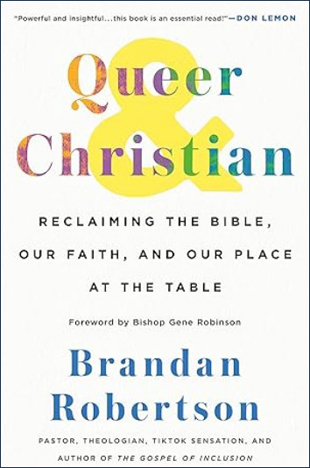
S&P's Contributing Editor, Jon M. Sweeney, had an “Off the Page" conversation with Brandan Robertson about “Queer & Christian" on May 29, 2025. Watch the video below.
Brandan Robertson has been preparing for this book all his life — going back to childhood when his dad called him a faggot, he suffered daily panic attacks at school, and he had thoughts of suicide; through his conversion to Evangelical Christianity as a young teenager; and including when he was a student at the ultra-conservative Moody Bible Institute in Chicago accepting the idea that his queerness needed fixing. There are painful scenes of enduring “conversion therapy,” when he was treated in ways so invasive that it’s a wonder he didn’t leave faith behind entirely. Robertson tells these stories with vulnerability and verve in the early memoir chapters of this book.
This is a book of empowerment for queer Christians. The author is one of the most articulate, fearless, and tenacious fighters against all the Christian preachers and teachers who have tried to bully queer people out of church for millennia. Queer and Christian is written with the passion of someone who now knows what’s real, what’s right, and wants to be sure that no one misses it in the ways he once did.
Robertson’s message is clear starting with the opening sentences of the Introduction: “ 'Perfect love casts out fear.' (1 John 4:18) The entirety of my faith is summed up in these five words from the Bible.” Then, on cue, just four sentences later he takes on his first bully, the popular Evangelical pastor and author John MacArthur (whose books Robertson must have read in Bible college), quoting him as saying, “The kindest thing you could ever say to someone engaged in homosexual sin is it is a sin that will damn you and it will exclude you from the kingdom of God forever.” This is why, years ago, he created a TikTok account, where today he’s pastor to nearly 275,000 people a day. In some of his posts there, he wears a shirt with a clergy collar, owning this role proudly and openly.
His passion is unyielding, as he refuses to concede the meaning of the Bible to those who weaponize it against queer people. Still, Evangelical techniques of persuasion and belief in the power of scripture remain strong within Robertson. For instance, when he writes about the early growth of that TikTok account he says: “Clearly, God was at work, not just in my own life but around the world, bringing about a reformation in the church for the inclusion and celebration of queer people.”
And he loves Jesus unabashedly, despite sharing the name “Christian” with many who profess the same without showing it.
Why does he fight so consistently? He explains this many times. “In millions of churches and hundreds of countries around the world, anti-queer theology and legislation will continue to roll forth unquestioned by those who hold the Bible to be a sacred text, based on inaccurate understanding and intentional manipulation of the Biblical text.” Chapters are then devoted to explaining issues of sexuality, gender, and love throughout the texts that Christians claim as scripture. “To help you reclaim the Bible as a tool for love instead of fear.”
There are dozens of texts discussed in close detail, always in language without “insider” talk: jargon-free. These include the passages in Leviticus about how men sleeping together is an “abomination.” Also, the story of Sodom and Gomorrah, and others from the Hebrew scriptures. From the New Testament, short chapters are devoted to Matthew 19:1-12, Romans 1, 1 Corinthians 6:9, 1 Timothy 1:10, Jude 1:7, and Acts 10-11. If you are queer and church-going you likely know some of these references, having heard them hammered against you. Robertson puts each into its proper context, showing consistently that the Bible, and the God of the Bible, is full of love not condemnation. Most efficiently and importantly, the end of each of these chapters has what Robertson offers as a “Quick Response” — a single paragraph to rebut the usual weaponization of that passage.
Part 3 offers chapters for queer people to “see ourselves in scripture.” These focus on Ruth and Naomi, David and Jonathan, Joseph’s “magic dress,” and from the New Testament, Jesus and “the beloved disciple,” as well as Simeon, the Ethiopian eunuch. Then, a final Part 4 offers eight chapters, each addressing a commonly asked question of queer Christians — such as “What’s a queer Christian sexual ethic?” (See the excerpt accompanying this review.)