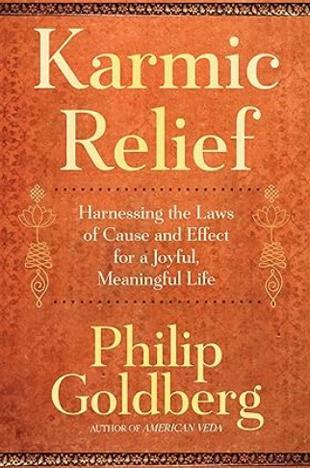
Our readers will know Philip Goldberg from his great book, American Veda, among many others that we’ve reviewed over the years. We also have audio clips, video clips, and e-courses with Phil, who is part of our Living Spiritual Teachers Project.
This new work maps the origins of karma in the world’s religious traditions, highlighting how the idea developed in history and how it eventually made its way to the West. There’s a lot of Hinduism and Buddhism in here, including Sanskrit phrases, the eight limbs of yoga, and the five niyamas of Patanjali’s Yoga Sutras. None of that overwhelms ordinary readers, however. It is all offered in Goldberg’s easy style. Most importantly, Goldberg pursues doggedly what karma actually means — and perhaps does. He is often suggestive, never prescriptive or dogmatic.
It is not a book primarilly designed for spiritual practice and yet Goldberg emphasizes, “We’re always planting karmic seeds,” and offers multiple examples of how karma seems to work and how, most of all, it is a wonderful idea. He also sometimes turns to practice, like when offering the following as two steps in a bulleted list of karmic practice ideas:
“Make a list of the virtues you would like most to develop, or that you think you need most to cultivate. The goal would be to make them your default behaviors.” And then later, “Employ the power of imagination to train your subconscious mind to initiate the desirable behavior when appropriate. Many athletes and other high performers use guided visualization to ‘rehearse’ inwardly. . . . Doing this frequently and regularly embeds the ideal action in the mind for transfer into speech and action.”
There are also chapters devoted to “Do the Right Thing” (Chapter 4) and “Don’t Do the Wrong Thing” (Chapter 5), showing how karmic teaching and practice can be seen, even if under different guises, in nearly every religious tradition, and how to begin to take it more seriously in your life where you are.
Practicality abounds here, amidst the history of an idea, as when the author suggests: “An effective repertoire of practices should make it far more likely that the seeds you sow will reap good karmic fruit. So, look for evidence.” He then offers questions designed for self-evaluation — how are you doing nowadays? “That’s how you know if you’re onto something good and your karmic graph is trending upward.”
But also important, according to Goldberg, is the idea that “there are always karmic waves on the way; they started rolling toward you a long time ago, and nothing is going to stop them. Things you don’t like will happen. . . . [D]on’t be shocked if you go through a stretch of hell after everything seemed heavenly.”
The author realizes that not everyone will see karma behind what happens to us, to others, or in the world. Toward the end of the book he sagely suggests, nonetheless, “Whether you call it collective karma, or the physics of interconnectedness, or just good citizenship, it is clearly a wise karmic strategy to contribute in some way to the well-being of the larger whole. The world needs evolving individuals who can dip into the depths of their being and pour into the world a measure of the serenity, compassion, love, and insight they find within.”
We were enlightened by this history of karma, and we needed this karmic practice advice.
Philip Goldberg on Kindness
View Philip Goldberg on Kindness directly: Vimeo.com/user5040879/goldbergonkindness