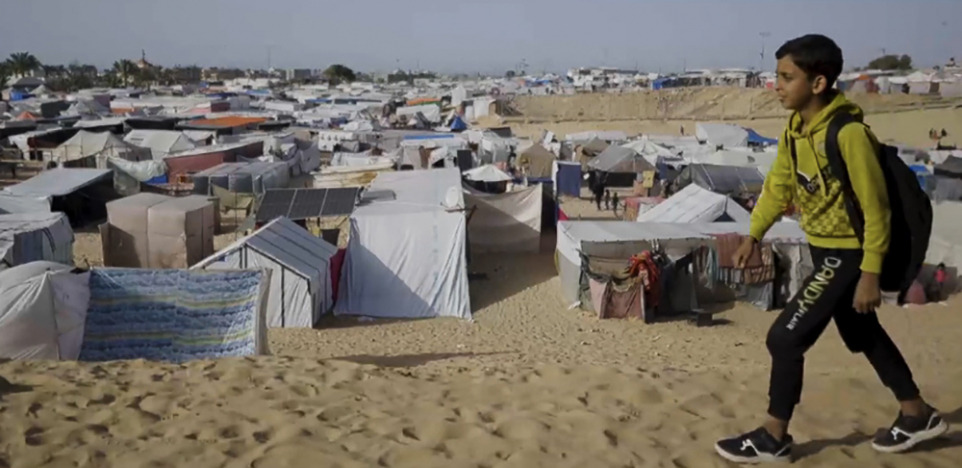
Since October 7, 2023, a war has been going on between Israel and Hamas-led Palestinian militant groups in the Gaza Strip. It is not the first conflagration between these parties. But the near total flattening of Gaza by Israel using American-made bombs and missiles has shocked many in the world community. Seeing report after report of houses, schools, hospitals, and farmland destroyed, learning of thousands of men, women, and children killed, we find ourselves yearning to hear what it is like to be there. For if we can’t see what is happening and have empathy and compassion for those suffering at this new “ground zero,” who are we?
Stories fill a gap when we are yearning to understand. As such they make good catalysts on our spiritual journeys. Some provide close encounters with the stories of our own lives; they help us identify the many voices inside us and to delve deeply into our feelings, desires, and passions. Our responses as we watching the news reveal what is important to us.
Second, stories can be a rendezvous with the shadow side of life. They encourage us to exercise our values and take stock of our commitments, to act on the promptings of conscience and intuition.
Third, throughout human history, stories have carried the message that we are not alone. How have others dealt with change, good and evil, success and failure, suffering and death? Stories show us. When we have questions, stories may not provide all the answers but they open some windows — acting as icons into the profound mysteries of life and death.
From Ground Zero: Stories from Gaza fulfills these three purposes of stories. The film is an anthology of 22 stories made by 22 different Palestinian filmmakers living inside Gaza during the war. Each story is 2 – 5 minutes long and reveals the diverse experiences of the Gazan people. The film genres used include fiction, documentary, docu-fiction, and experimental cinema.
Since half of the residents of Gaza are children, many of the stories focus on what they are going through and how, through their creativity, they try to make sense out of their constricted and constrained world. One five-year-old girl mentions that her one-year-old brother only speaks two words so far: “Daddy” and “WEE-oww-WEE-oww” (the sound of a siren).
These stories are all tributes to the resilience, creativity, sorrow, joy, and hope displayed by the Gazan people. Here are just a few examples of the 22 short films:
- In “Selfie,” a young woman writes a letter to be thrown in a bottle into the sea in which she describes her daily struggles. She puts on makeup in order to maintain her femininity.
- In “No Signal,” a middle-aged man digs in the rubble for his brother after he thinks he gets a response from his cell phone.
- In “All Is Fine” a stand-up comic prepares to entertain a small group of people.
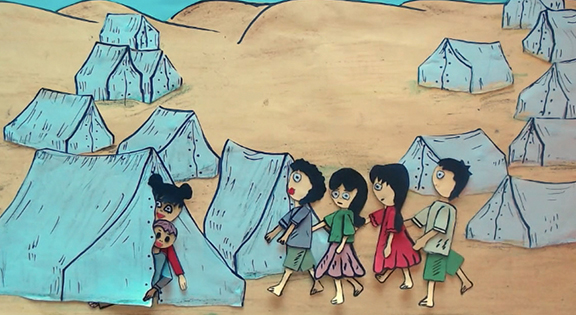
- In “Soft Skin,” a classroom of children make an animated film. You can see it here.
- In “The Teacher,” a man who had been a teacher wanders through the rubble-filled streets to find water and food for his students.
- In “A School Day” a young boy puts his school books in his backpack, then walks across town to the cemetery and sits at the grave of his teacher.
- In “24 Hours,” a man describes how he was targeted and buried under rubble three times in the same day.
- In “Recycling,” a woman gets one can of water from a distribution center and then at home uses it for drinking, bathing, washing dishes, washing clothes, and watering the plants.
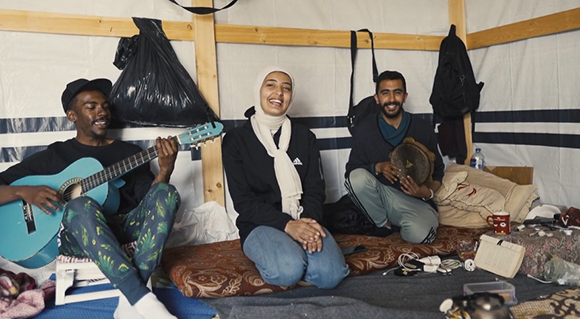
- In “No,” a woman seeks out artists to help her say “No” to what is happening. A group of musicians sing: “Tomorrow we will forget the crises, they will pass. And we will see beautiful smiles again. Forget and try to stay calm. It’s certain, the happy days will return.”
- In “Farah and Myriam,” young Farah recounts how many of her family members have been killed. She dreads nighttime because “Whenever the sun goes down, I lose someone.”
- In “Out of Frame,” a Palestinian artist, hoping to display internationally, returns to her home and finds her paintings, sculptures, and other creations amidst the rubble.
- In “Awakening,” Father, Mother, and Son puppets wonder why they must live in a tent. They conclude: “This war is not like all the others. This time there is nothing left. They have destroyed everything. Everything is gone. It’s as if the world ceased to exist. Everyone is just watching.”
From Ground Zero: Stories from Gaza is a compelling call for us to quit “just watching” and work for peace and a new free life for the Gazans.