The Life of Chuck is a genre-bending story about three chapters in the life of an ordinary man named Charles Krantz. It is based on the 2020 Stephen King novella featured in his collection If It Bleeds. You will recognize some of King’s common interests: ordinary people having extraordinary experiences, the effects of childhood trauma, and the need to make choices under pressure. But whereas King is known for his horror stories, this one, as directed by Mike Flanagan, is full of reflections on hope, cosmic truths, the meaning of every life, and the reality that everyone belongs in a larger universe. Twice in the movie, these lines from Walt Whitman’s poet “Song of Myself” convey the key theme of the film:
“I am large,
I contain multitudes.”
The story is told in reverse chronological order. It is genre-bending because it starts out as an end-of-the-world catastrophe movie, then turns into a showcase for dancing, and finally becomes a coming-of-age story about a seven-year-old boy who lives with his grandparents. Throughout the performances are superb, bringing what could be a confusing storyline into our understanding.
Act Three (which opens the movie): Thanks Chuck
In a high school classroom we learn that the world is in dire straits. After an 9.1 earthquake, most of California has fallen into the ocean. There is no Internet. Disease, floods, and other disasters are occurring all over the world.
Marty (Chiwetel Ejiofor), an English teacher, and his ex-wife Felicia (Karen Gillan), who works at a hospital where the staff now call themselves the “Suicide Squad,” talk over the situation on the phone and then together. “If the world is going down the drain and all we can say is ‘That sucks,’ maybe we are going down the drain too,” they decide. He tells her about Carl Sagan’s Cosmic Calender, and they wonder if the Earth is in the final second, i.e. the last times.
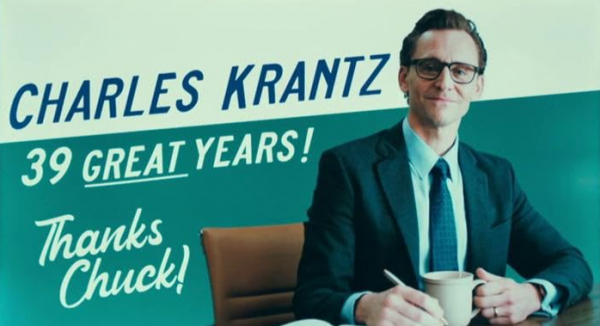
They also wonder about the presence of billboards, signs, TV and radio ads, writing from a plane, and huge pictures in the windows of houses of a middle-aged man and the message is “Charles Kranz, 39 Great Years. Thanks Chuck.” Who is Chuck? Felicia wisely observes: “The world is full of mysteries.”
Act Two: Buskers Forever
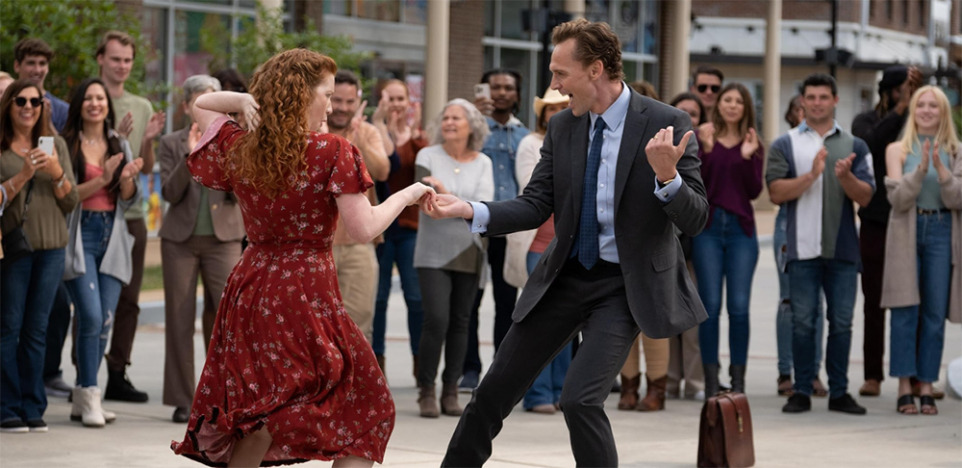
In this act, three characters interact in a celebration of dance. Taylor (The Pocket Queen) is a drummer who sets up her drum kit in a square and, considering the beat to be her friend, goes with whatever rhythm comes to her. Janice (Annalise Basso) has just been dumped by her boyfriend. Charles “Chuck” Krantz (Tom Hiddleston) is an accountant in town for a conference.
Walking down the street, Chuck stops where Taylor is playing and begins dancing. When he spots Janice also moving to the beat, he invites her to join him. Soon a crowd has gathered to watch an energetic, joyous, totally improvised dance performance. “Why did you stop?” Taylor asks later, and Chuck says he doesn’t know. Why did he start dancing, he wonders. Another mystery.
Act Three: I Contain Multitudes
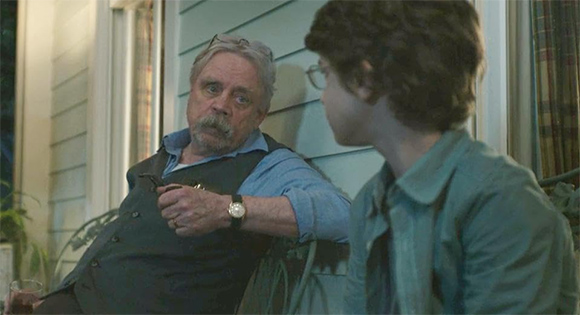
In this act, Chuck (Benjamn Pajak) is in grade school. His parents have died in a car crash and he is living with his grandparents (Mark Hamill, Mia Sara) in an old Victorian house with a cupola. That room is a source of fascination to Chuck but he is forbidden to go into it. Why? Another mystery.
At home, Chuck begins dancing with his grandmother. At school he joins the Twirlers and Spinners Club, where is teaches the best girl dancer (Trinity Jo-Li Bliss) how to do the slide. Dancing is his route to recognition at school, but his grandfather wants him to study math. He tells him math is needed in the world and it is an art.
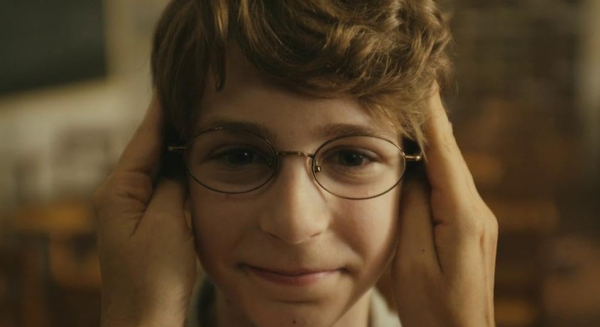
The key to understanding the thematic threads of Chuck’s story – the cosmic calendar, the environment, dancing, waiting to find out what’s happening, family and community history, math – is in one scene at school. Chuck asks his teacher (Kate Siegel) to explain the line from Whitman’s poem “I am large. I contain multitudes.” She puts her hands on his ears and explains. (You need to see the film for this scene alone.) This sets Chuck on a new path. He realizes how connected he is to everything and that every moment is worth remembering.
There is a spiritual mantra here that we could all use during times of stress and difficulty and also during times when we feel like dancing. It’s the best affirmation you’ll hear in all of 2025’s films:
“I am wonderful.
I deserve to be wonderful.
And I contain multitudes.”