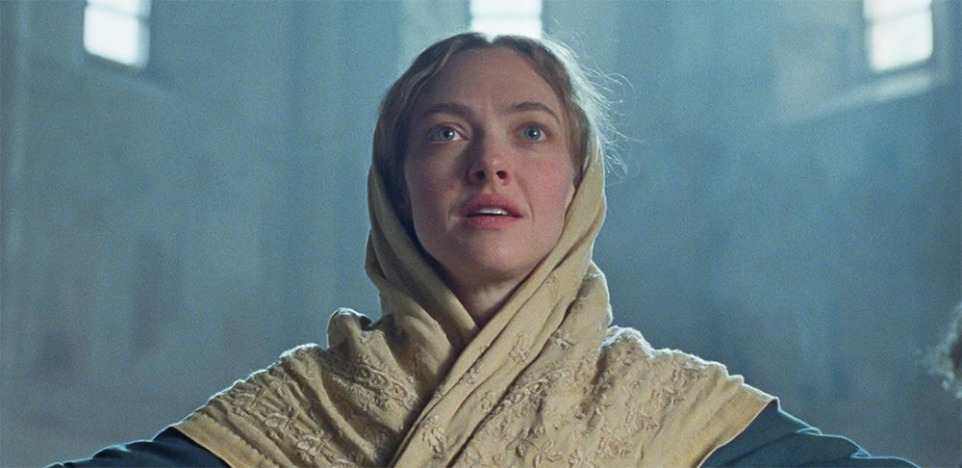
Some will remember Norwegian director Mona Fastvold for another historical drama with a setting in the early United States — 2020’s The World to Come, starring Casey Affleck and Katherine Waterston. It was a film with spiritual nuance, but not religious, as this one is.
From the opening credits of The Testament of Ann Lee, there is music and it is eerie, as we see Shakers in the woods praying and dancing, singing “make a faithful record of Mother Ann Lee, the woman clothed by the Son.” The score is similar to what you might hear in a horror film. You sense right away that this film will blend historical reality with creative, interpretative, musical drama.
The opening scenes are in England, where Ann Lee was born in 1736 in the city of Manchester. Her parents are Christians of the Church of England sort, at least at the beginning. But soon young Ann is influenced by what the English call “dissenters,” influenced by street preachers decrying the “ritual and power” of Anglicanism, and the revivalist George Whitefield, one of the founders of Methodism.
A narrator is there, from the opening scenes, when Ann is a girl. A period-accurate voice narrator is, in fact, perhaps too much a presence. I wished at times that the actors and filmmakers might tell the story themselves without the voice on high. The narrator, for instance, tells us that little Ann saw “heavenly visions” — but then the film also shows us what she sees in the form of angels and saints and a serpent, from museum-grade oil paintings.
When the young adult Ann first appears, we are not yet eight minutes in, and immediately we see her in religious ecstasy. She is played by Amanda Seyfried, whose movie career has fascinatingly grown from a silly character, Karen Smith, in the raunchy Mean Girls of 2004, to an amazing Cosette in Les Misérables of 2012, to this. Seyfried is now forty years old and in this movie she poignantly plays Ann from her late teenage years until her death at the age of 48.
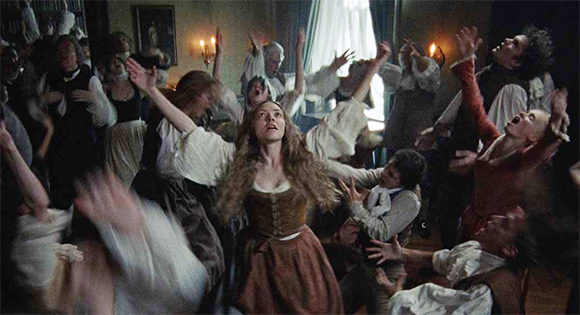
Ann has joined the young Quaker movement and is in the middle of a room of worshippers thrusting arms in the air, jumping in place, and screaming with lament and praise. Then we see a Quaker meeting and how the sect focused on “inward experience,” which often took the form of public confessions followed by “shaking” off the effects of sin. At first, Ann seems fearful of what’s happening, but then, organically becomes a part of it, as if unable to resist.
The prayer meetings are more choreographed than chaotic, in their leaping and dance and song, but the film manages to maintain both qualities throughout. That said, the movie is more like a musical than not, given the fitness of every actor on screen.
Ann has gone from working in the mills to working as a cook in an infirmary, and we discover that her mother is dead. Her closest friend is her brother, William. Skillfully played by Lewis Pullman, William will eventually accompany Ann to America, becoming her most devoted evangelist. He goes from being her brother William to “Brother William.”
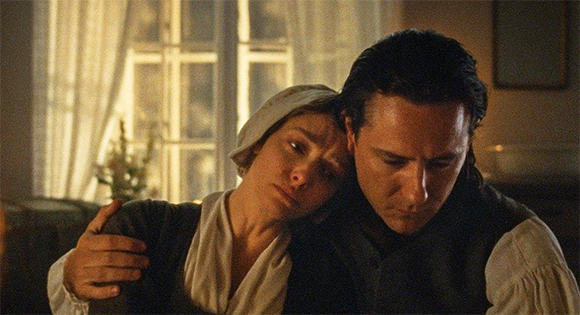
Just as Ann begins to become a charismatic leader of Quaker worship and belief, she also becomes a wife, “having caught the eye of a man of the same faith, Abraham, a blacksmith,” the narrator says. The marriage is not good from the start. Then Ann gives birth to four children, all who die in infancy. She is bereft. In one scene, Abraham comes and says, “I have to take it from you,” referring to the dead child that she won’t let go of. “No!” Ann screams, and Abraham slinks away.
Light — and the lack of it — is almost another character in this drama. Outdoor scenes usually are filled with shadows, and indoor scenes always incorporate windows, candle and gas light, but are still often dark.
Sex and the human body are also important. Ann had a hatred of sexual relations from an early age from watching her parents do it across the room where the family slept together but in separate beds. In the following scene, Ann confronts her father about what “he does to her mother,” and her father responds with a caning.
Still a teenager, Ann becomes a virtuoso of kinesthetic worship. In fact, the choreography of prayer and praise scenes — sometimes without words, but often to what became popular Quaker hymns — is some of the most creative religious filmmaking I’ve ever seen. It’s hypnotic.
Grieving her children, Ann spends time in the infirmary where she once worked, this time as a patient. But the film also shows that Ann was becoming a mystic of the first order, a woman of divine vision and touch. “She converted her suffering into evangelism,” the narrator says.
Leaving the infirmary, and still with Abraham, Ann becomes a Shaker leader, as Quakerism evolves into this new form of faith. But the group is subjected to attack and imprisonment by government officials for disturbing the peace, and local mobs who attack them for being different. It is in prison in Manchester, in suffering and weakness, that we see Seyfried (Ann) sing the traditional Quaker hymn, “Hunger and Thirst” to comfort herself, and it is a highlight of the movie. The chorus goes:
I hunger and thirst
I hunger and thirst
After true righteousness
I hunger and thirst
I hunger and thirst
I hunger and thirst
After true righteousness
I hunger and thirst.
Seyfried has a beautiful, clear voice; it is a powerful scene.
 Emerging from prison, Ann is even more the leader of this religious sect, telling stories of the visions she has seen, with the others waiting on her words. She also begins to speak “in tongues” — meaning, saying spiritual truth in languages that she wouldn’t have known how to pronounce. The group begins to speak of Ann as “Christ’s second coming,” and as the feminine manifestation of the Divine in history.
Soon, a small group of Quaker pilgrims leaves England, with a financial supporter, traveling across the Atlantic. The year is 1774. They end up settling first “up the Hudson” in upstate New York, later expanding as far west as Ohio, and northeast up to Maine, where one can still find the last remaining Shakers at Sabbathday Lake.
Abraham leaves Ann soon after they arrive in the new world. She had become convinced that sexual relations of any kind are a sin, and that sex itself is the cause of the catastrophes of the world. Accepting that belief most of her flock stay celibate, replenishing their community only by adopting orphans. (At one point there were almost 6,000 Shakers; only three remain today.)
Watching the film, I was amazed at the gritty reality with which bodies are shown: Ann in raw childbirth, for example, and Ann under torture. The thrusting and pounding of hands and feet in trance-like prayer. Never have I seen a film that so beautifully and powerfully shows the human body in all of its raw, sometimes naked, authenticity. We see the goriness of a body being beaten, the realness of birth, and the eroticism of marital sex.
The film also depicts Ann’s brother, William, as gay, leaving behind a same-sex relationship in England in order to follow his sister’s leadership and his own commitments of faith. This is a theory that scholars have pursued: that the Shakers, like the Catholic priesthood, have attracted LGBTQ+ people who are drawn by faith as well as a path of sexual safety.
With Ann Lee becoming “Mother,” the leader of the group in America, one watches as Shakers ecstatically worship, preach to farmers and townspeople, withstand attackers, build their beautiful furniture and houses, all behind a score of original Shaker hymns in modern adaptations, and skillfully directed by Fastvold (who also co-wrote the screenplay), filmed by cinematographer William Rexer, to simultaneously show historical period details while making it all seem timeless.
I found myself comparing this movie to O Brother, Where Art Thou? from 2000, directed by the Coen Brothers, even though theirs was a comedic musical drama, and often satirical. There is nothing satirical or comedic here, but there are moments when a character breaks into song. And as a strange coincidence, as I was thinking the O Brother, Where Art Thou? comparison in the theater, actor Timothy Blake Nelson appeared on the screen; he was one of the three wanderers in O Brother, and in The Testament of Ann Lee he plays a sectarian mystical preacher who himself becomes a follower of Mother Ann.
How the Academic of Motion Pictures skipped this film for award nominations is beyond me. In my opinion, Director, Cinematography, Actress, Screenplay, Supporting Actor, and Best Original Score, are all warranted.