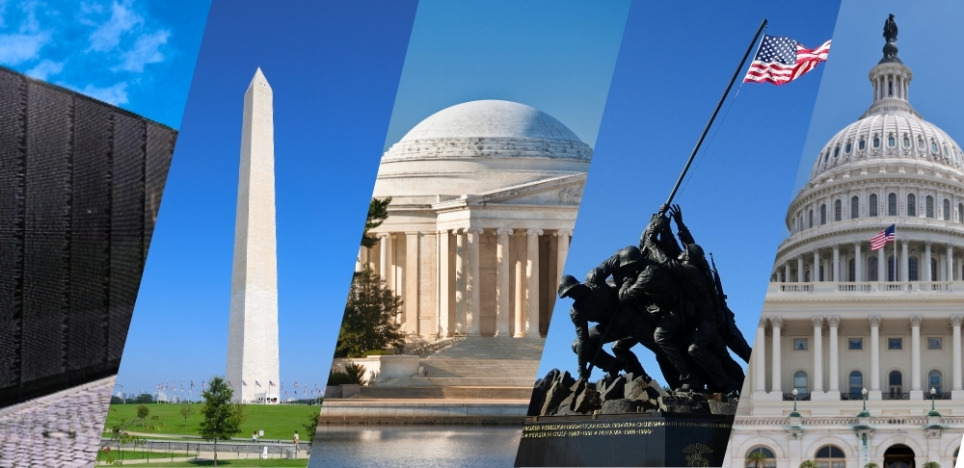
I spent last week in Washington, D.C., and the landscape inspired a particular kind of awe in me. I could not get over the blind resolve — the arrogance — the naiveté – it takes to erect a monument! To set a person or an idea in 32,000 tons of marble, too heavy ever to move, too rigid ever to modify, and too public ever to obscure!
I biked around the National Mall, visiting monuments and enjoying moments when, all of a sudden, I caught a glimpse of the White House or the Capitol building. These structures have been symbols all my life, metonyms for the history and governance of my homeland, and now here they were: present and close. There was some magic in that.
But overall, it didn’t work for me. Or maybe I should say, it didn’t work on me, this propaganda that history and its men should be cast in marble and worshiped in perpetuity. It really shouldn’t work on any of us if our education system is functioning properly.
Because eventually we all learned that George Washington, an otherwise discerning leader who modeled the peaceful transfer of power, enslaved hundreds of human beings. And we learned that Thomas Jefferson, drafter of the Declaration of Independence, serially raped women. No neoclassical architecture can make me forget or excuse that depravity.
Of course, these men were human. If they could ask for forgiveness, I would give them grace — but I would never give them 32,000 tons of marble and a place at the seat of power forever.
The monuments I experienced felt spiritually illiterate to me, testaments to the mistaken idea that assertions of political power can overcome time, progress, and reflection.
And so I started to be on the lookout for spiritually literate documentations of history.
I walked the Vietnam Veterans Memorial, down and up that wide V that names an obscene number of American dead. I watched a young boy’s face as he listened to a volunteer tell him that 3 out of 4 of those names were men under the age of 21. I felt that whole scene in my gut. This memorial worked on me . . .
. . . until I exited the V. I stopped to look at a map and heard that young boy’s mother marvel at how many of “our young men” were lost.
As beautiful and effective as the Vietnam Veterans Memorial is, it is political art, partial and nationalistic.
The memorial’s effect — the lament over “our young men” — is not sufficient, not when Vietnam lost at least four times as many people.
What a beautiful statement it would be if the other side of Maya Lin’s black granite walls was filled with the names of the Vietnamese dead.
What would the effect be on American tourists to see that the names of just the South Vietnamese, our allies, could not fit on this American wall? How would our global futures be different if tourists saw that, even in a smaller font, the names of all Vietnamese victims trailed off the granite wall, too numerous to be memorialized?
That would be a spiritually literate memorial, a way of honoring the dead that is not influenced by nationality, othering, and militarism but by a recognition of our interconnectedness and the exercise of empathy.
So this week, I invite you to think about the concept of spiritual literacy when it comes to how we document and display history.
1. How can monuments acknowledge their own vulnerability to revisions and revelations that change our sense of history?
2. Reflect on my feedback for the Vietnam Veterans Memorial. Is there an existing memorial or monument that you think should be revised so that it is more spiritually literate? What would you change? Do you think these changes could actually be made? How/who could you organize in this effort?
3. Alternately, start from scratch. Think of a person, event, or idea that you want to memorialize for public education. How could you design it so that it is spiritually literate, motivated not by divisions and rigidity but by the spiritual practices of connections, compassion, justice, and peace?
- See more Spiritual Resources for the U.S. Election Year.
- To receive these weekly features in your inbox on Mondays, subscribe to the Practicing Democracy Project email list here.