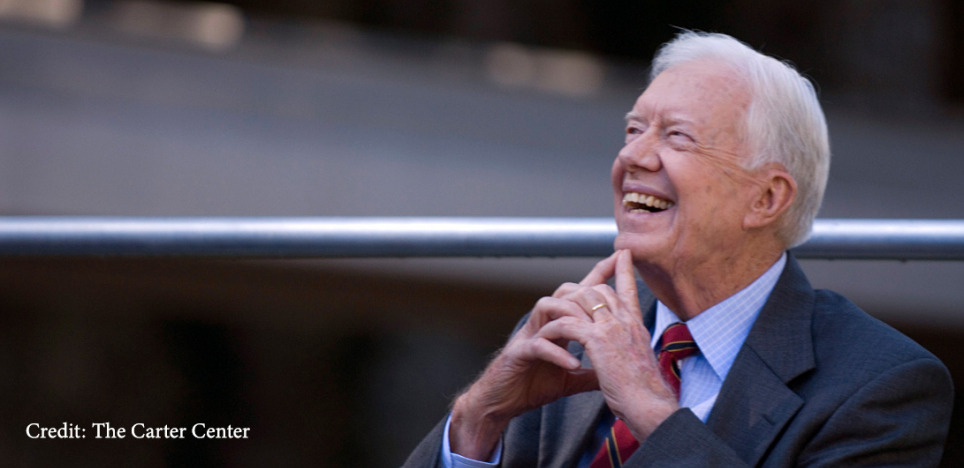
James Earl Carter, Jr., served as the 39th President of The United States of America from 1976 - 1980. He was born on October 1, 1924, and died on December 29, 2024.
Carter was raised in rural Georgia and enjoyed a successful Navy career until his father’s death in 1953, at which time he moved back home with his wife, Rosalynn, to operate Carter Farms and seed warehouse. Carter invested heavily in the community, serving on boards and eventually entering local, then national, politics.
Carter’s years as President were marked by significant accomplishments in foreign policy, energy management, and environmental protection. In particular, Carter negotiated the Camp David Accords, normalized diplomatic relations between the U.S. and the People’s Republic of China, and doubled the size of the national parks system.
Frederic Brussat notes that Carter’s devotion to his Christian beliefs influenced his Presidency; “that commitment to the Prince of Peace was evident in his presidency, during which he never ordered a bomb to be dropped or a missile to be launched.”
Political accomplishments notwithstanding, Carter will be remembered mostly for his transformational post-Presidency. He continued his public service by establishing the Carter Center, which works across the globe addressing the ills of disease, war, human rights abuses, and political corruption. The Center has had life-saving impacts through public health initiatives, especially on the continent of Africa, and helped to raise the worldwide immunization rate from 20 to 80 percent by 1990. When the Carter Center began a program to eradicate infections of the meter-long Guinea worm that emerges painfully from sufferers’ skin and incapacitates them for long periods, 3.5 million people a year in Africa and Asia were infected; in 2022 there were only 13 known infections, in 2023 there were 14. So far in 2024, there have been 7.
President and Mrs. Carter also became known and loved for their work with Habitat for Humanity, where they volunteered for over 30 years, working side-by-side with other volunteers to build over 4,000 homes and call attention to the need for affordable housing.
Carter wrote more than 30 books in his lifetime, reflecting on American history, the Middle East, his life and family, aging, and his Christian faith.
In 2002, the Norwegian Nobel Committee acknowledged Carter’s impact on the world by honoring him with the Nobel Peace Prize. They cited his “decades of untiring effort to find peaceful solutions to international conflicts, to advance democracy and human rights, and to promote economic and social development.”
To Name This Day:
- Share how President Carter impacted your life by signing the official online condolence book.
- Review his remarkable life in more detail by visiting the Carter Center Timeline.
- Carter’s deep love of music helped connect him to young voters and anchor him in Civil Rights issues that marked the South he grew up in, represented, and worked to heal and transform. Remember his enthusiasm by enjoying the film Jimmy Carter Rock & Roll President
- To celebrate and be inspired by Carter’s commitment to peace, watch Jimmy Carter Man from Plains, a documentary that revolves around Carter’s book tour for Palestine: Peace not Apartheid.