Posted by Frederic and Mary Ann Brussat on February 26, 2016

In a post on cnn.com from November, 2015, Catherine E. Shoichet reports on a CNN and Kaiser Family Foundation poll showing that half of Americans — 49% — say racism is a big problem in society today. This percentage is higher than it was in 1995 following the O. J. Simpson trial and the Rodney King case when 41% of Americans described racism as "a big problem."

Shoichet talks to people who say that the news stories that they've seen of unarmed African men being shot by police have angered them. Others are upset about the failure of the justice system in the shooting death of Trayvon Martin or after the Charleston church massacre. Many are convinced that minorities are still at a disadvantage when it comes to wages and accessibility to jobs.

Mark Naison, a professor of history and African-American studies at Fordham University, notes the "simmering rage" swirling around the issue of racism: "Latent racism is becoming more open, because a lot of people are feeling threatened."

On the other hand, Naison sees more people talking about race than ever before. He compares it to a therapy session on a national scale. Talk is a good place to start, we'd add, but then the conversation must lead to positive action.
Posted by Frederic and Mary Ann Brussat on February 22, 2016

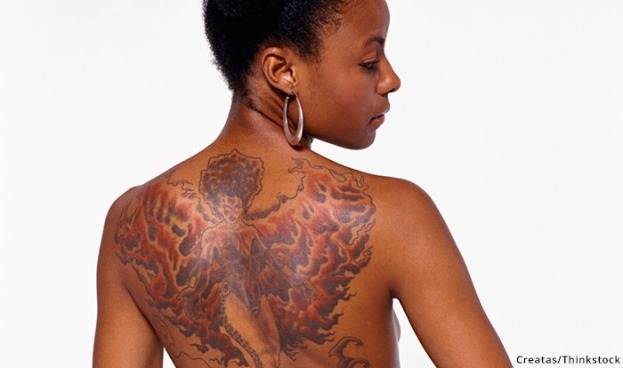
There was a time when most people thought that tattoos were just embraced by merchant marines, bikers, and goths garbed in black. But now they are part of mainstream cultures around the world. Body adornment has lost its marginal status and acquired glamour. Of course, youth have adopted this use of the flesh to set themselves apart from older generations. But as Cassandra Franklin-Barbajosa in an online article for National Geographic Magazine, tattoos are part of a rich cultural history going back 5,000 years.

She presents examples of body modification by Egyptians, Romans, and Crusaders of the 11th and 12th centuries. Perhaps the most exotic tattoos were used by inhabitants of the South and Central Pacific islands where "when in mourning, Hawaiians tattooed their tongues with tree dots. In Borneo, natives tattooed an eye on the palm of their hands as a spiritual guide that would lead them to the next life." Franklin-Barbajosa also takes a look at the tradition as practiced in Japan for beautification and magic.

Today's tattoo devotees spend time at international fairs and conferences where this art form is respected, even if it has become an individual act of consumption. What has caused this renaissance of interest? "The melting pot that is the United States has no rites of passage as a single American culture," says Ken Brown, a tattoo artist in Fredericksburg, Virginia. "On some levels, getting a tattoo is like a milestone that marks a certain moment in a person's life." Spiritual people recognize this as art, as beauty, and as ritual.

Posted by Frederic and Mary Ann Brussat on February 12, 2016

Is hope the antidote to the largest and most dangerous spiritual emergency of our times? Kate Davies, a climate change activist and writer, surveys the scene in this thought-provoking article in Tikkun Magazine. There are still billions of people around the world who are operating on the "business as usual model" where economic growth and consumerism are seen as cultural imperatives, despite the resulting trashing the environment. Others operate on the "Great Unraveling Model" where the destruction of the earth is viewed without any shock, sorrow, or regret.

Davies suggests . . .

Posted by Frederic and Mary Ann Brussat on February 8, 2016

In a well-done and needed essay in The Aspen Journal of Ideas, Scott Barry Kaufman, the Scientific Director of the Imagination Institute in the Positive Psychology Center at the University of Pennsylvania, challenges us to move beyond our culture's obsession with "evaluation" (tests, entrance exams, and constant measurement of our talents and abilities in regular job performance reviews). He suggests we open ourselves to a culture where the catalyst is "inspiration."

This psychological and spiritual quality . . .

Posted by Frederic and Mary Ann Brussat on February 1, 2016

Many young adults setting out to work in today's high tech world and changing economy are concerned about being rootless in a time when nothing lasts forever and work is now a very transitory thing. They have questions about what's essential. Do they need success strategies or job search suggestions? In a thought-provoking essay on Aeon Magazine Karl Pillemer, a professor of gerontology writes about youth who are most interested in finding a purpose in life. He has discovered the benefits of talking to elders about their lives and choices in the quest of not a purpose but purposes.

Marjorie Wilcox warns . . .

Posted by Frederic and Mary Ann Brussat on January 25, 2016

In an article for alternet.org Chris Hedges examines the strong connections between being poor and going to prison in the United States. Of the 2.2 million people locked up at the moment, 97% of federal cases and 95% of all state felony cases are resolved through plea bargaining. Why so many? Hedges reveals that many of these cases involve poor people of color who don't have enough money for a substantive legal defense. The Guardian newspaper reported that since 1989, false confessions were made in 28 percent of all the DNA-related exonerations.

Hedges offers brief looks at three resources on the repercussions of this blatant civil rights issue. One is the ten-part Netflix documentary "Making a Murderer" which charts "the endemic corruption of the judicial system." The second is Matt Taibbi's "The Divide: American Injustice in the Age of the Wealth Gap" in which we learn how rights are revoked for the poor and civil liberties have been changed into privileges for the rich. The third is an article by Judge Jed S. Rakoff in The New York Review of Books titled "Why Innocent People Plead Guilty" where the author shows how the secretive pleas system works to contaminate justice.

Hedges writes: "If you are a poor person of color in America you will understand this with a visceral fear. Being poor has become a crime. And this makes mass incarceration the most pressing civil rights issue of our era."

January is "Poverty in America Awareness Month," a time to contemplate not only the link between poverty and incarceration, but also how poverty puts people in the greater prisons of fear, danger, and despair. Many aspects of this reality are explored in our topic pages on "Poverty." Here you will find links to reviews of pertinent books, soul-stirring excerpts, teaching stories, prayers, poems, or thought-provoking quotations.

Posted by Frederic and Mary Ann Brussat on January 21, 2016

In an ethically revealing article from Truthout.org, Adam Hudson presents a hard-hitting overview of the battle raging between the U.S. National Parks and the bottled water industry (Nestle's Arrowhead, Pepsi's Aquafina, Coca-Cola's Dasani). So far 20 parks have gone bottled-water-free, and the campaign by the big-name corporations against this development has heated up.

Here are a two of their arguments:

Posted by Frederic and Mary Ann Brussat on January 19, 2016

In 1990, we read and reviewed The Call of Stories: Teaching and the Moral Imagination by Robert Coles, a professor of psychiatry and medical humanities at Harvard, who had pioneered a new class at Harvard Business School titled "The Business World: Moral and Social Inquiry Through Fiction." Coles was bound and determined to let the great fiction books about people in business "work their magic on the heart." He also was seeking to foster in the students an empathetic identification with the protagonists in the novels.

All of this came back to us . . .

Posted by Frederic and Mary Ann Brussat on January 11, 2016

In "America and Its Fellow Executioners," the Editorial Board of The New York Times states that the death penalty must be seen for what it is: "morally unacceptable, inhuman, barbaric, unjust and useless." According to the annual report by Amnesty International, the United States is among five countries — the others are China, Saudi Arabia, Iran and Iraq — still relying upon this lethal form of punishment.

The Editorial Board also states that "there is no compelling evidence that the death penalty deters crime, whether murder or terrorism. And absent deterrence, what remains is just vengeance." In addition, their case against this cruel and unusual punishment is bolstered by the fact that more than 150 wrongfully convicted individuals on Death Row in the U.S. have been freed since 1973.

We commend this condemnation of this abominable practice and eagerly look forward to the day when more and more counties will adopt anti-capital punishment laws.

Posted by Frederic Brussat on January 8, 2016

In an interview with NPR about his latest novel Avenue of Mysteries, John Irving states: "I've always written about what I fear. Maybe the most autobiographical element in my novels is that they're not at all about what has happened to me, they're much more about what I'm afraid of, much more about what I hope never happens to me or to anyone I love."

the protagonist in this novel . . .

RSS

About This Blog

Spiritual literacy is the ability to read the signs written in the texts of our own experiences. It is recommended and practiced in all the world's religions. Whether viewed as a gift from God or a skill to be cultivated, this facility enables us to discern and decipher a world full of meaning. More