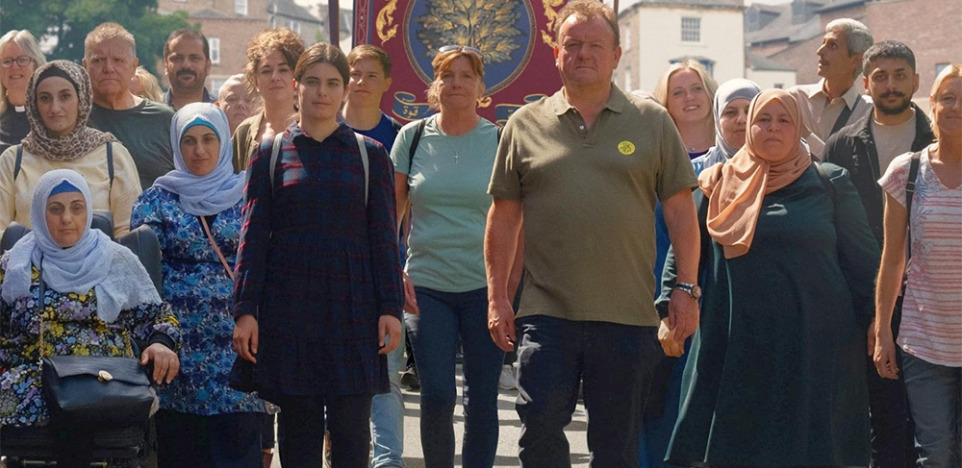
British filmmaker Ken Loach has directed 27 features films and countless shorts, documentaries, and TV dramas. Now 87, he has declared that The Old Oak will be his last film. It carries on the emphases we’ve seen in his other films, including Bread and Roses, The Wind that Shakes the Barley, I, Daniel Blake, and Sorry We Missed You: the social and political challenges facing working-class people, the dehumanizing effects of poverty, the difficulty of dealing with government bureaucracies and new work arrangements like the gig economy, and the need for both resilience and action. By revealing the everyday lives of his characters, he gives us a harsh yet realistic look at what marginalized groups go through. Yet a thread of hope also weaves its way through his stories.
The Old Oak is the last pub in a once thriving mining town in northern England. Its owner, T.J. Ballantyne (Dave Turner), has made it into a refuge welcoming the unemployed and disgruntled villagers. It is the one place where they can express their frustrations with the system after a strike closed the mines.
Their voices get louder and more angry when a group of Syrian refugees moves into the community. The locales have no sympathy for these newcomers, even though they have had to flee the civil war in their country. They see them as a threat and certainly don’t want to share the town’s resources with them.
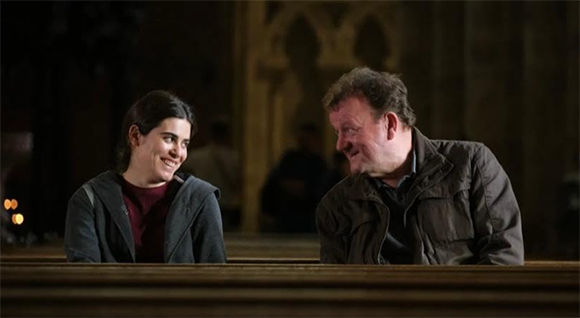
T.J. befriends one Syrian woman, Yara (Ebla Mari), after her camera is destroyed by a local man. He shows her a room full of photographs in the back of the pub which reveal what life was like when the mines were open. After she notices a sign in one photo, “When you eat together, you stick together,” they hatch a plan to bring the community together.
Contemplative philosopher and interspiritual pioneer Beatrice Bruteau once asked “How big is your we?” She wanted us to expand our vision of community beyond our own skin, family, race, tribe, culture, country, and species. Her question was both spiritual and political.
The Old Oak illustrates how a community can go about expanding its “we” by practicing hospitality, kindness, and unity. When T.J. welcomes Yara and her people, he encourages others to show them some kindness, and the Syrians in turn return kindnesses. This interchange creates a sense of unity among people previously very divided.
These days, when there are more than 43.7 refugees in the world, a film like this one stands out as a shining example of not only hope but also realistic possibilities. It is a fitting conclusion to Loach’s cinematic legacy.