Until several years ago, the messages I heard about Israel-Palestine could be reduced to this: it’s complicated.
I was told – weren’t most of us, in the West, at least? – that there is so much history involved, so much conflict. Impossible to unravel.
The issue was presented as a task for the experts, a calculus problem without a Good Will Hunting plot device. And so, for a very long time, I didn’t probe.
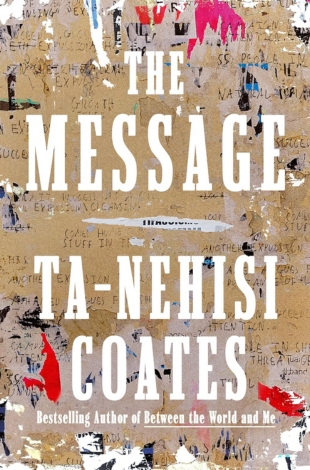
Neither did Ta-Nehisi Coates. His new book, The Message, tells the story of his own submission to the machine of professional obfuscation. And while much of the power of this book certainly comes from his witness to the conditions in Palestine, the heart of The Message is a fact that has been hiding in plain sight for 50 years — right there on our doorsteps every morning, on the evening news, and populating our newsfeeds:
“ … from 1970 to 2019, [historian Maha] Nassar found that less than 2% of all opinion pieces discussing Palestinians had Palestinian authors.” America’s “papers and magazines preferred writing about Palestinians to allowing Palestinians to write.”
How can anyone claim to characterize the relationship between Israel and Palestine – much less proclaim its “complexity” – while ignoring the voices of Palestinians?
The Message depends on the messenger.
What Coates finds touring Palestine is that what was presented as complex looks quite familiar to a Black American with a clear view of history. It looks, simply and horrifyingly, like the Jim Crow South, like mass incarceration, like South African Apartheid.
And so in addition to writing journalistically about his personal observations in Israel-Palestine, Coates does historical work. He plumbs the archives of Zionism and measures the depths of Israel’s affinity for the same ideologies and practices that enriched South Africa and the United States: the racism, white supremacy, and cultural superiority that underwrote massive theft.
Much of this material is shocking because, in the West at least, we are accustomed to the discourse of Israeli innocence and exceptionalism. It is a service to our understanding of that region that Coates has uncovered and highlighted the ways in which Israel is a nation like any other.
There are two short chapters that precede the very long chapter on Palestine: one in which Coates, for the first time, returns to Senegal (his first time visiting the land of his ancestors) and one in which he travels to South Carolina to visit a schoolteacher who violated a state law against teaching critical race theory. (The lesson in question was based on Coates’ bestselling memoir Between the World and Me, which we featured in our We the People Book Club.)
What holds these travels together are questions about writing, the imagination, and power. We need stories to survive, especially when reality is deadly. But how should we hold our myths, and what do we do with them when we have real power, enough to make others our victims?
Coates speaks in uncharacteristically spiritual language when advocating for the kind of power he deeply believes in: “A literature fueled by a profound human experience must necessarily burn at a high flame, and thus a ‘material handicap’ is transformed into a ‘spiritual advantage,’ putting in the hands of the oppressed ‘the conditions of a classical art,’ which is to say the power to haunt people, to move people, and expand the brackets of humanity. This is as true for those laboring under the shadow of enslavement as it is for those laboring under the shadow of apartheid.”
The Message is certainly a red-hot flame, and some have received the book and felt burned. (Watch Coates’ interview on CBS from September 2024 and his response to it on Democracy Now.) We feel that the book eloquently and responsibly expands the bracket of humanity in a way that is long overdue.
The next step for all of us is to engage with work by Palestinians.
Here’s a start:
Research the work of Omar Suleiman, one of our Living Spiritual Teachers.
Watch these films which present a Palestinian perspective:
Rana’s Wedding,Paradise Now and Omar by Hany Abu-Assad
Allah Made Me Funny: Live in Concert featuring Mo Amer
Slingshot Hip Hop by Jackie Reem Salloum
Laila’s Birthday by Rashid Masharawi
State 194 about Palestinian Prime Minister Salam Fayyad
Salt of This Sea by Annemarie Jacir
Divine Intervention by Elia Suleiman
Read these books that feature Palestinian writers:
This is Not a Border: Reportage and Reflection from the Palestinian Festival of Literature by Ahdaf Soueif and Omar Robert Hamilton
Bethlehem Besieged: Stories of Hope in Times of Trouble by Mitri Raheb
The Hour of Sunlight: One Palestinians Journey from Prisoner to Peacemaker by Jen Marlowe and Sami Al Jundi
I am a Palestinian Christian by Mitri Raheb